
Manifesting my 2026 (and beyond) Dream Projects
This is a weird time to be a self-employed GLAM consultant. Like many other consultants in this sector, the impacts of federal funding cuts to GLAM institutions have rippled out to my business, and this year’s business revenue has dropped dramatically. The first two years of Memory Rising were enormously successful, but things began to get bumpy right around spring 2025 because of an unfortunate convergence of the impacts of the new presidential administration and some serious personal challenges outside my control that came up (which are thankfully now almost resolved). Right now my major goal is to find a way to keep my business running despite the larger economic uncertainty. It turns out I love this way of working, and really enjoy the ability to work with a variety of clients and projects.
Given this transitional period in my business and while I am between major long-term client engagements, it seems like a good time to step back and think about the projects I’d love to work on. Tom Critchlow’s blog post about manifesting his dream clients really resonated with me as a way to publicly articulate the kinds of projects I’d really like to work on next. Some of these ideas come directly out of other client projects I’ve done, others are more about my own niche interests. Across all of them, I think there’s real potential to imagine some new and exciting collaborations. I’ve sketched out a few notes about all of these projects below.
These projects are arranged in three big buckets of my major work interests (archives and climate change, Ohio Valley history and culture, and New Deal history). If any of this is compelling to you, or you have ideas, please get in touch with me! I’d love to talk more, even if it’s just a brainstorming session.
Archives and climate change
Tracking Climate Change Impacts on Cultural Heritage
- What I envision: Creating a map of cultural heritage institutions that have been impacted by floods, hurricanes, tornadoes, wildfires, and other disasters that are becoming more frequent and severe due to climate change. I’d also like to write a recurring newsletter covering various news stories about this, potentially with some original reporting as well.
- What’s already been done (by me or others): A while ago I set up several Google news alerts and started a pilot project tracking some of the early 2025 Los Angeles wildfires and their impacts on Los Angeles area cultural institutions. This is a logical outgrowth of some of my previous work on the RepoData project which attempted to track the locations of all US-based archives, as well as subsequent projects such as PROTECCT-GLAM.
- What collaboration/partnership/support could look like: This is a project I’m comfortable bootstrapping initially, since I have some basic map visualization skills (see the RepoData ArcGIS map and StoryMap) and am willing to learn as far as I can go with free or low-cost online mapping software. However, I’d like to eventually partner with either a major professional GLAM association (e.g., SAA, AIC, AAM, ALA) and/or an environmental adaptation organization (e.g., American Society of Adaptation Professionals) for a more official open-ended long-term project that could scale with additional technical assistance. I could also see a collaboration with a major climate change-focused media outlet, such as Inside Climate News or Grist. A partnership like this would at minimum provide more visibility for the project, and ideally would be a source of funding to pay me for the time it takes to research and verify damage reports, as well as the fees for hosting/subscription services with a company like ArcGIS.
Assessing current levels of sustainability efforts/climate adaptation in research libraries
- What I envision: While there are many benchmarks for measuring research library work such as collection and use statistics (for example, the Association of Research Libraries statistics), to my knowledge there is not yet a way to track what research libraries are doing when it comes to sustainability measures. In my teaching and research, I am regularly asked what other large institutions are doing, and I’ve accrued a slowly growing list of case studies and examples from what I see at conferences and in publications. However, this isn’t very systematic. I think a survey of what’s out there would have to take place before any meaningful benchmarking could take place.
- What’s already been done (by me or others): A great recent example from the cultural heritage field is Environment and Culture Partners project Culture over Carbon. This was a collaboration with the New Buildings Institute (NBI) and New England Museum Association to run a pilot study of museums’ building energy use. This is the kind of pilot work that is useful for then building out further guidelines and benchmarking for sustainable energy use for the museum field.
- What collaboration/partnership/support could look like: I don’t have a very clear sense of what collaboration or partnership might look like here, especially given the retreat from coordinated research efforts for the GLAM profession (e.g., the DOGE attacks on federal granting agencies that might support research like this, staff layoffs/departures at OCLC Research, etc). Potential collaborators might include parties such as ARL, Ithaka S+R, or Association for the Advancement of Sustainability in Higher Education.
Carry out a nationwide records survey of environmental justice and climate change-focused collections
- What I envision: This idea comes directly out of my recommendations associated with my final report for the Mellon Foundation, Public Knowledge program. I’d like to coordinate conducting a major nationwide records survey of environmental justice and climate change-focused collections across America’s archives that would identify subject and geographic areas of strength, areas lacking documentation, and form the foundation for future documentation efforts.
- What’s already been done (by me or others): I undertook some preliminary research around the availability of these types of collections while working on the report mentioned above, and part of my interest in pursuing this is because I noticed some major regional variations in what I was able to determine from finding aid websites, and would like to see a more formal survey to substantiate whether there really are regional variations in terms of collection availability. There is significant precedent for identifying existing records around various topics that could be adapted for this project, such as the Black Metropolis Research Consortium’s survey of African American archives in the Chicago area.
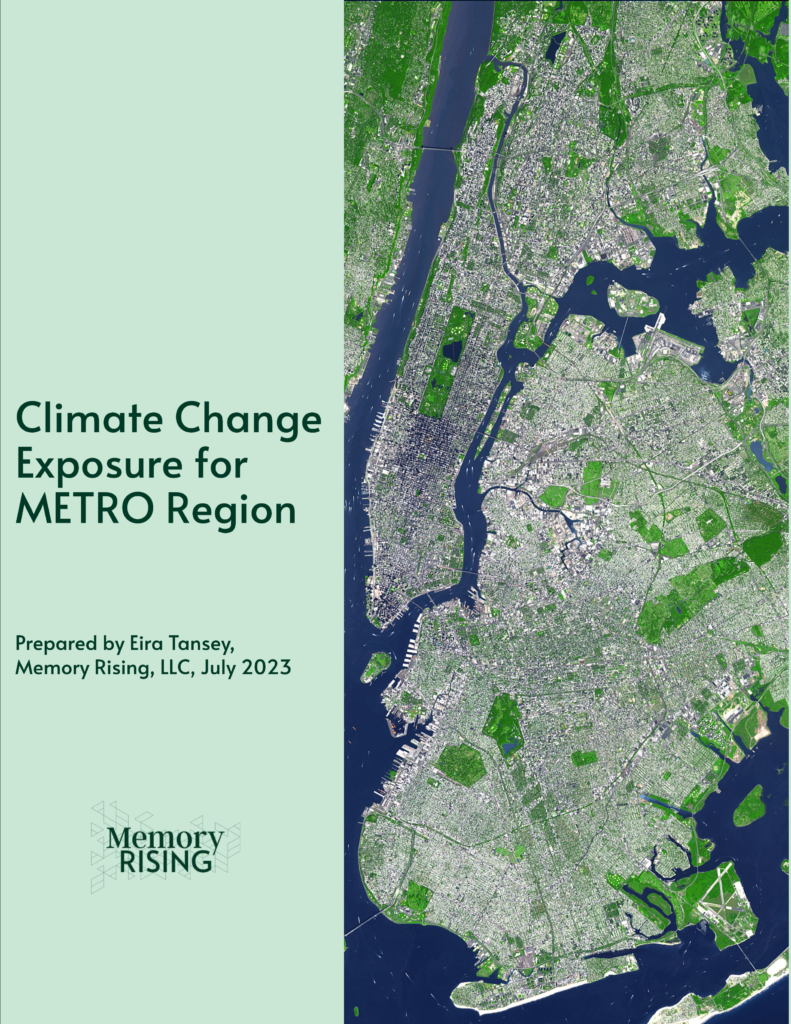
- What collaboration/partnership/support could look like: I’d love to see this be a partnership between an established GLAM organization that has committed to prior work on climate change (for example, CLIR or METRO) and another organization that represents potential users of EJ and climate change related collections, such as the American Society of Environmental History or the Society of Environmental Journalists.
Coordinate a nationwide state-based traveling archivist program prioritizing climate readiness
- What I envision: This idea comes directly out of my recommendations associated with my final report for the Mellon Foundation, Public Knowledge program. The majority of American archives have three or fewer full-time equivalent employees. Many archival records also exist in settings in which there is not a single professional full-time archivist on staff, such as small public libraries, small museums, community archives, religious archives, historical societies, and other similar settings. To quickly scale reaching as many archives as possible, a nationwide state-based traveling archivist program should be developed to send archivists to these settings to assess the breadth of their records, evaluate critical needs, provide basic education and training for archives management, and identify those archival records most at-risk for climate change impacts. This is by far the most ambitious project on this list, but I also view it as foundational to another project I’d like to eventually see that I mentioned in both the Mellon report and a publication for A Green New Deal for Archives, which is to create a nationwide planning effort to support proactive safety and possible relocation for the most vulnerable archives.
- What’s already been done (by me or others): Several successful traveling archivist programs have been introduced and supported by State Historical Records Advisory Boards (SHRABs), which are currently active in about half of US states and territories. A major dependency associated with this recommendation would be activating SHRABs in states in which they are currently inactive, or finding alternative organizations to function in the place of a SHRAB. These successful models could be scaled up and expanded with the goal of reaching and supporting many more institutions that steward archival records. Current funding limitations for SHRABs typically mean that traveling archivists usually perform baseline assessments and training, but funding a nationwide program at a larger scale would allow for greater hands-on technical assistance and potential longitudinal data collection.
- What collaboration/partnership/support could look like: The Council of State Archivists would be an obvious partner for such a project, since it both has the membership base of state archives, and also involves coordinating research and support for state and territorial archives, such as the recent Archives Working Across Remote Environments (AWARE) project that I had the great honor to work on as the lead consultant. Most SHRABs get funding from the National Historical Publications and Records Commission (NHPRC), and given some of the instability of funding from federal grantmaking bodies, particularly for climate change work, additional funding sources might also need to be sought out. And maybe in a future world we can pass the Public Archives Resiliency Act, which was introduced in Congress last year and would go a long way towards addressing these issues.
Support for Ohio Valley archives and history
Developing Collaborative Archival Services Membership Model for Ohio River Valley non-profits/social enterprise businesses/working artists
- What I envision: There is such a vast and colorful community of nonprofits, arts organizations, social enterprise businesses, and working artists in the Ohio River Valley. Some of them have existed for decades, and have accumulated a ton of historical records about their legacy and community work. Based on my conversations with some of these organizations, they often want to do cool things with their archives but don’t have the time or resources to bring on a full-time archivist, nor is there an obvious pathway to raise funds to bring in a dedicated consulting archivist like myself. I envision creating a kind of collaborative archival services membership model that combines a traveling archivist who can provide microservices of collection assessment, processing, exhibition support, research, etc along with quarterly workshops for all members.
- What’s already been done (by me or others): There are examples of preservation/conservation service centers that offer membership services for collecting institutions and individuals (e.g., the Midwest Art Conservation Center and the Conservation Center for Art and Historic Artifacts). To my knowledge, no one has yet developed a regional archival services membership model that specifically serves nonprofits/arts organizations/businesses/individuals to maintain their own archives.
- What collaboration/partnership/support could look like: Given the resource constraints of many of the potential members for an archival services membership, I’d really like to develop a relationship with some major Cincinnati philanthropic/nonprofit organizations to obtain funding in order to subsidize this model. Such a model would potentially include paying me a living wage to manage an archival services membership model and deliver services to client members, potentially pay subcontractor archivists for additional technical assistance if demand exceeds my capacity for directly serving members, and reduce the cost of membership for small organizations.
A guide to 1937 flood markers
- What I envision: The 1937 Ohio River flood retains the record for the most devastating flood in the Ohio River valley. More than 300 people died and one million were homeless. Since it took place during the Great Depression, it also coincided with the New Deal transformation of the federal government beginning to take a more active role in disaster response (and it also coincided with one of the most iconic photographs taken during the Depression). Even though most of the survivors of the 1937 flood are long gone, if you drive around the Ohio River valley you can see all sorts of flood markers on buildings documenting the flood line. To my knowledge, there is not a map listing as many of the flood markers as possible.
- What’s already been done (by me or others): Whenever I’m traveling in communities bordering the river, I always keep an eye out for these markers (they’re often quite subtle!). So far I have several pictures of them in my files from Ripley, Ohio down to Paducah, Kentucky. There’s also a few that are listed in the Historical Markers Database. The Cincinnati & Hamilton County Public Library Genealogy & Local History Department has a terrific online exhibit about the impacts of the flood in the Cincinnati area in addition to a large collection of digitized photographs.
- What collaboration/partnership/support could look like: The 90th anniversary of the 1937 flood will be taking place in about 18 months, so this seems like a great time to prioritize this project! I would love to collaborate with an organization such as Ohio River Way to send me on some research trips to Ohio River communities to identify flood markers, build a map, and set up a system for additional user submissions.
Preserving Ohio River Valley Labor History Archives
- What I envision: I’d love to see a revival of the Ohio Labor Archives project. This was a project carried out in the 1970s/1980s between the Ohio AFL-CIO and the Ohio Historical Society (now known as the Ohio History Connection). This project identified historically important labor union records across the state, and ensured that many important labor collections ended up preserved in some of the former Ohio Network destinations. This is why labor history is very well documented across Ohio through about the 1980s, but more recent labor collections are hard to come by. I’d love to pick up where this project left off by building relationships with Ohio’s labor unions and working with them to determine how best to preserve the records (whether in-house or by transferring them to a receiving archive).
- What’s already been done (by me or others): The Guide to Primary Sources in Ohio Labor History is the essential output from the original project. ArchiveGrid also has catalog records/finding aids of many of the archival collections and oral histories preserved as part of the original project.
- What collaboration/partnership/support could look like: The Ohio AFL-CIO would be critical to making some of the connections to labor unions around the state. While the state of Ohio archives/humanities grant funding is still on shaky ground due to the challenges with federal grantmaking, there are a ton of labor research and history organizations out there that might be potential supports, such as LAWCHA, Labor Heritage Foundation, American Labor Studies Center, Labor Research and Action Network, and the United Association for Labor Education.
New Deal history
Scale up the NO TIME FOR FEAR podcast
- What I envision: I launched NO TIME FOR FEAR back in January, and love doing it. Given the completely stupid and unnecessarily cruel current political timeline we live in, I feel more strongly than ever that the lessons and legacy of the New Deal can show us a way for improving Americans’ lives nearly a century later. Ideally the podcast is on a monthly release schedule (which has had some bumps this year due to some personal challenges I’ve had to manage), but I would really like to obtain enough financial support to scale it to be two times a month, with the extra episodes tracing the through line between the legacy of the New Deal and current politics. Ultimately my goal is to get the podcast to a place where it has enough financial backing to make it a reliable stream of anchor income for my business, hire a production/research assistant, and pay guests an honorarium.
- What’s already been done (by me or others): Of all the projects on this list, this one is the most advanced already, and something I am totally committed to finding a way to keep it going and ideally scaling up. So far the podcast has been downloaded over 1,000 times. I’ve been pleasantly surprised that with very little effort on my part (basically, mentioning donation options at the end of the podcast and including a donation button on the podcast website), I’ve already received several donations from listeners totalling a few hundred bucks. This has just about covered much of the audio editing costs, since I currently outsource the final editing to a podcast editing company.
- What collaboration/partnership/support could look like: I’m going to be extremely real here and say: if you are one of these Democratic operatives looking to invest in progressive influencers, drop me a line. Making a history-based podcast is not for the faint of heart, and my solo episodes require many hours of research which I would really, really like to get paid for. Other history podcasts (like Ben Franklin’s World) have partnered with history-based organizations. I’d love a potential partnership with organizations like the Living New Deal or the Frances Perkins Center. I’m also open to short-term collaborations; for example, the next season is going to be about Social Security, so I could see a short-term sponsorship with an organization dedicated to aging and elderly rights.
Mapping availability of New Deal related archives
- What I envision: I had a conversation with Gray Brechin (founder of the Living New Deal) years ago when I was writing A Green New Deal for Archives, and this idea came up related to a potential mapping project for archives related to New Deal figures and projects (parallel to the Living New Deal’s existing efforts to map the infrastructure, architecture, and other sites associated with the New Deal.
- What’s already been done (by me or others): OCLC’s ArchiveGrid would be a useful starting point for identifying collections with public finding aids, and SNAC would be useful for identifying New Deal figures. There are also additional analog resources worth consulting, such as SAA Guide to the Historical Records Survey.
- What collaboration/partnership/support could look like: The Living New Deal would be a terrific partner for this project, especially given the rich set of resources that already exist on their website meant to guide folks for New Deal research.
Writing a book about the 1930s era of American archives history
- What I envision: Three major centennials are coming up in the next decade: the founding of SAA (1936), the establishment of the National Archives (1934), and the Historical Records Survey (1936). When I wrote A Green New Deal for Archives, it became really clear to me how much the ethos of the New Deal progressive mindset permeated the early formalization of American archivists as a profession distinct from historians (a process that had started decades before, but really cemented due to the confluence of archival milestones in the 1930s). I’d love to have the time and resources to explore this in a book that could coincide with the centennial of these events.
- What’s already been done (by me or others): Back when I wrote my author analysis of American Archivist I became very familiar with the early authors featured in the journal, many of whom held positions in federal agencies and so would have been familiar with the New Deal themselves. I’ve saved a lot of those articles in my files. Other people have done some great work on looking at 1930s archivists who really embody the New Deal spirit, such as Peter Binkley’s work on his grandfather Robert C. Binkley, and Margaret Cross Norton.
- What collaboration/partnership/support could look like: This effort is definitely going to take some research funding, and a lot of the federal research funding for public humanities/historical research, especially for independent scholars, is either actively being DOGE’d or has disappeared altogether. The SAA Foundation would be an obvious partner for funding this research, though while I am on Council there would probably be a conflict of interest in terms of obtaining funding. Otherwise, perhaps a foundation dedicated to good governance might be a natural fit for funding this research.